The Next Generation of PayGo: Connecting Onchain Capital with Community Energy

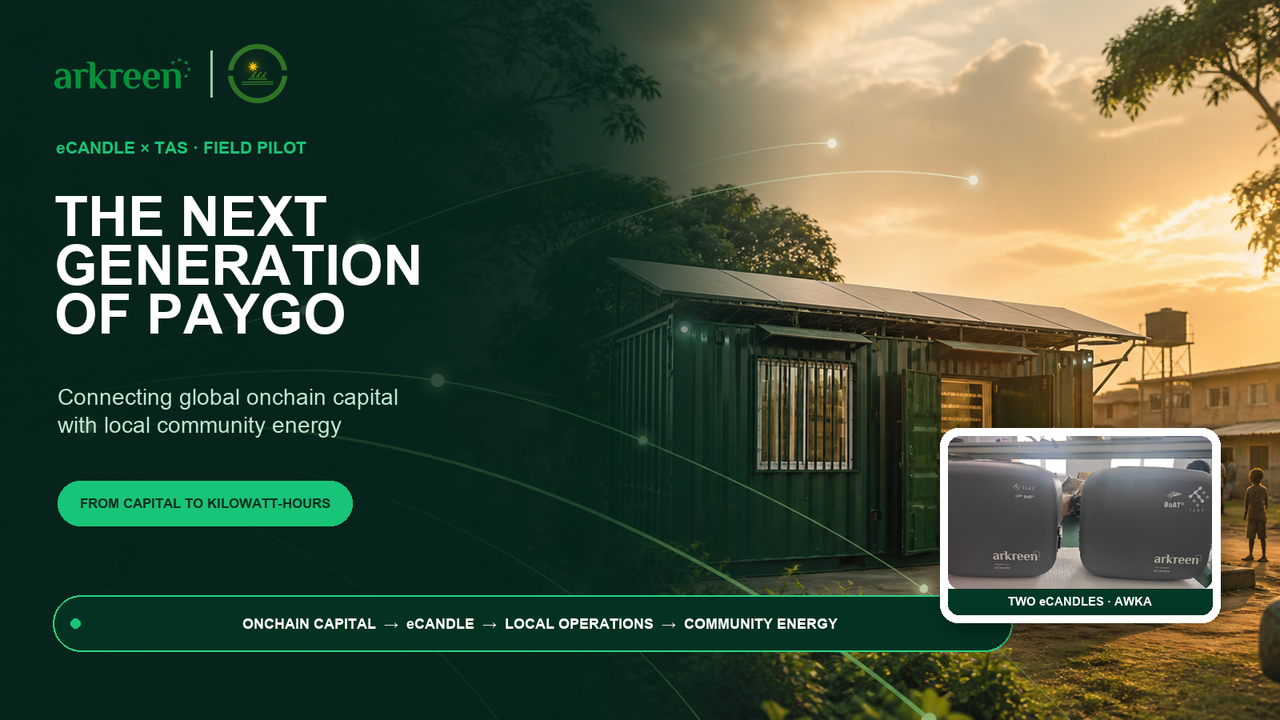
Through its TAS pilot in Awka, eCandle is exploring how global capital, programmable energy hardware and local community operations can work as one system.
Two eCandles are making the final leg of their journey to Awka, Nigeria.
After development, integration, international shipping and customs clearance, the two 1 kWh energy devices have been repacked and are heading to the TAS pilot site. There, they will leave the controlled environment of the laboratory and begin operating in a real community setting.
The pilot starts with two relatively small machines. But behind them is a much larger question:
Can an energy device become the coordination point between global onchain capital, local operators and community energy demand?
The Awka pilot is an early step toward answering that question.
PayGo Changed the Way Energy Infrastructure Reaches Users
Pay-as-you-go models have already played an important role in expanding access to distributed energy.
Instead of requiring a household or small business to purchase an energy system upfront, PayGo allows users to pay gradually or according to their actual usage. This reduces the initial financial barrier and makes energy services available to people who may not have access to conventional financing.
This model has helped solar home systems, appliances and other distributed infrastructure reach new communities. It has demonstrated that financing, hardware and payment logic can be combined to create more accessible energy services.
But deploying hardware is only the beginning.
A sustainable energy service also requires capital, installation, maintenance, payment collection, customer support and reliable information about how the equipment is performing. These responsibilities are often distributed across different companies and systems that do not easily communicate with one another.
Global capital may be interested in supporting productive community infrastructure, but small distributed assets are difficult to evaluate and monitor. Local operators may understand community demand, but lack access to flexible financing. Users may need energy, but require payment methods that match the scale and frequency of their needs.
The next generation of PayGo must therefore do more than connect a payment to a device.
It must coordinate capital, hardware, operators and users as parts of one system.
What Would the Next Generation of PayGo Look Like?
The next generation of PayGo could build on the success of existing models while making the relationships between participants more programmable and transparent.
In this model, energy hardware would not function only as a financed asset with an on-and-off switch. It would become an active part of the operating network.
The device could:
- Deliver and measure physical energy.
- Receive usage-based payments.
- Connect payment confirmation with energy access.
- Record operating activity through blockchain infrastructure.
- Give local operators better visibility into device performance.
- Create verifiable evidence that could support future deployments.
Stablecoins can provide a useful settlement rail for this model. They make it possible to transfer relatively small amounts of value digitally, across borders and between different participants.
Blockchain records can help establish a shared operating history. Rather than depending entirely on reports produced after the event, participants could gradually gain access to more consistent records of usage, payments and device activity.
The purpose is not to place energy infrastructure onchain simply for the sake of using blockchain.
The purpose is to help parties that operate in different locations and under different conditions coordinate around the same physical energy service.
eCandle as a Coordination Node
eCandle is designed as a 1 kWh energy node that connects physical energy delivery with digital payment and operating records.
For a community user, the experience should remain simple. The user identifies an available energy service, scans a QR code and completes a stablecoin payment. Once the payment is confirmed, the corresponding energy access can be provided.
Behind that interaction, several layers must work together.
The energy system must be available. The device must understand the requested service. The payment must be received and confirmed. Access must be activated correctly. The local operator must be able to support the user, and the activity must be recorded in a form that can help evaluate the pilot.
Arkreen provides the onchain energy protocol layer that connects these different parts of the process. The protocol is intended to link energy activity, payments and operating records while creating a foundation for wider coordination with onchain capital.
At the machine level, TLAY’s BoAT technology provides the integrated machine-wallet capability that allows eCandle to participate in the payment flow.
But the significance of eCandle is not simply that a battery can have a wallet.
Its significance lies in what that energy device may eventually coordinate: capital that supports deployment, a local partner that operates the service, community users who create real demand, and verifiable activity that helps all participants understand what is happening.
Why Local Operations Matter
Digital protocols cannot replace trusted local operations.
Someone still has to receive the equipment, inspect it, install it and keep it working. Someone must explain the service to users, respond when something goes wrong and understand which applications are genuinely valuable to the community.
This is why TAS is a central partner in the Awka pilot.
TAS brings local knowledge, community relationships and practical operating capacity. Its role is not limited to providing a location for the two eCandles. TAS will help determine how the devices should be introduced, how users interact with them and what a workable daily operating process looks like.
The community context matters because a technically successful transaction does not automatically create a useful service.
A QR payment may work perfectly, but the overall model will still fail if users do not understand it, if the available services do not reflect local demand or if the operator cannot maintain the equipment efficiently.
Onchain capital may help fund infrastructure. Arkreen can provide the protocol. eCandle can deliver and measure energy.
But only a capable local operator can turn those components into a service that people actually use.
How the Awka Pilot Will Work
Once the two eCandles arrive at the TAS site, the first phase will focus on installation, configuration and basic operational testing.
The devices will then be introduced into community-oriented usage scenarios. These may include practical needs such as charging, connectivity, lighting and other everyday activities supported by reliable electricity.
The intended user journey is straightforward:
- A community user requests an energy service.
- The user scans a QR code.
- A stablecoin payment is initiated.
- The payment is confirmed through blockchain infrastructure.
- eCandle provides the corresponding energy access.
- TAS supports the user and manages the local service.
- Device activity, payment and operational observations are recorded.
The pilot will explore more than whether electricity can flow from the battery to an appliance.
Arkreen and TAS will examine whether the payment experience is understandable, whether energy access responds correctly, whether the equipment performs reliably and whether TAS can operate the system efficiently.
Community feedback will be equally important. The pilot should reveal which services are most useful, which steps cause confusion and what must change before the model can be deployed more widely.
Building Operational Proof
The Awka pilot is not yet a complete demonstration of global onchain financing for distributed energy infrastructure.
It is intended to establish something that must come first: operational proof.
Before capital can confidently support a network of physical assets, the network must demonstrate that it can operate.
That means generating evidence of:
- Real community demand.
- Real energy delivery.
- Real stablecoin payments.
- Real operator workflows.
- Real device performance.
- Real user feedback.
- Real technical and operational constraints.
The goal is not merely to prove that a 1 kWh battery can charge a phone or power an everyday device.
The goal is to understand whether energy hardware, programmable payments and local operations can function together as one repeatable service.
Some of the most valuable outcomes may be lessons about what does not work as expected. A field pilot exposes details that cannot be fully reproduced in a laboratory: connectivity limitations, user behavior, operating costs, environmental conditions and the practical realities of maintaining equipment.
These lessons are necessary if eCandle is to become more than a product demonstration.
From Operational Proof to Capital Coordination
If eCandle can produce a reliable record of energy activity, payment and local operations, it may provide the foundation for a wider capital coordination model.
The long-term loop could work like this:
Onchain capital supports eCandle deployment. Local partners operate the devices. Community users purchase energy services. Device activity and payments create verifiable operating records. Those records help inform future capital deployment.
For capital participants, this could create better visibility into how physical assets are being used.
For local operators, it could provide a path to acquire and operate more energy infrastructure without relying entirely on traditional financing channels.
For communities, it could support wider access to useful energy services without requiring every user to purchase a complete system upfront.
For Arkreen, eCandle provides a physical example of how an onchain energy protocol can coordinate value around real infrastructure.
The model is not intended to remove human relationships or local responsibility. Instead, it is designed to make cooperation between global and local participants easier to understand, measure and potentially scale.
Capital alone cannot operate a community energy service. Local knowledge alone cannot always finance infrastructure. Hardware alone does not create a sustainable operating model.
The opportunity lies in connecting them.
What Success Would Mean
Success in Awka will not be defined by a single transaction or a photograph of the devices being switched on.
It will mean that community users are willing and able to use the service. It will mean that the payment process is understandable, that energy is delivered reliably and that TAS can manage the system without unnecessary operational complexity.
It will also mean that the records produced by the pilot provide a credible picture of what happened in the field.
Did users complete payments successfully? Did the devices respond correctly? What types of energy services were most useful? What support did users require? How much operational effort was needed from TAS? What should be improved before another deployment?
Answers to these questions can help Arkreen and TAS evaluate whether the model has the potential to expand.
They can also help define what information future capital participants would need before supporting additional devices and communities.
The Journey Starts in Awka
The eCandle pilot begins with two devices, one local operating partner and a community environment in Awka.
That is deliberately small.
New infrastructure models should not begin with assumptions about scale. They should begin by proving that the smallest complete version of the system can create value.
For eCandle, that complete system includes more than a battery. It includes the protocol that connects energy with blockchain infrastructure, the local operator that turns hardware into a service, the community users who create real demand and the possibility of global capital supporting future deployment.
The question behind the pilot is larger than the devices themselves:
Can global onchain capital, programmable energy hardware and trusted local operators coordinate to deliver useful energy where it is needed?
The answer will not be written in a laboratory or a white paper.
It will begin in Awka—with real users, real payments, real energy delivered and lessons learned alongside the community.